

Poster Printer Machines Transform Science of Reading in 2026 Classrooms
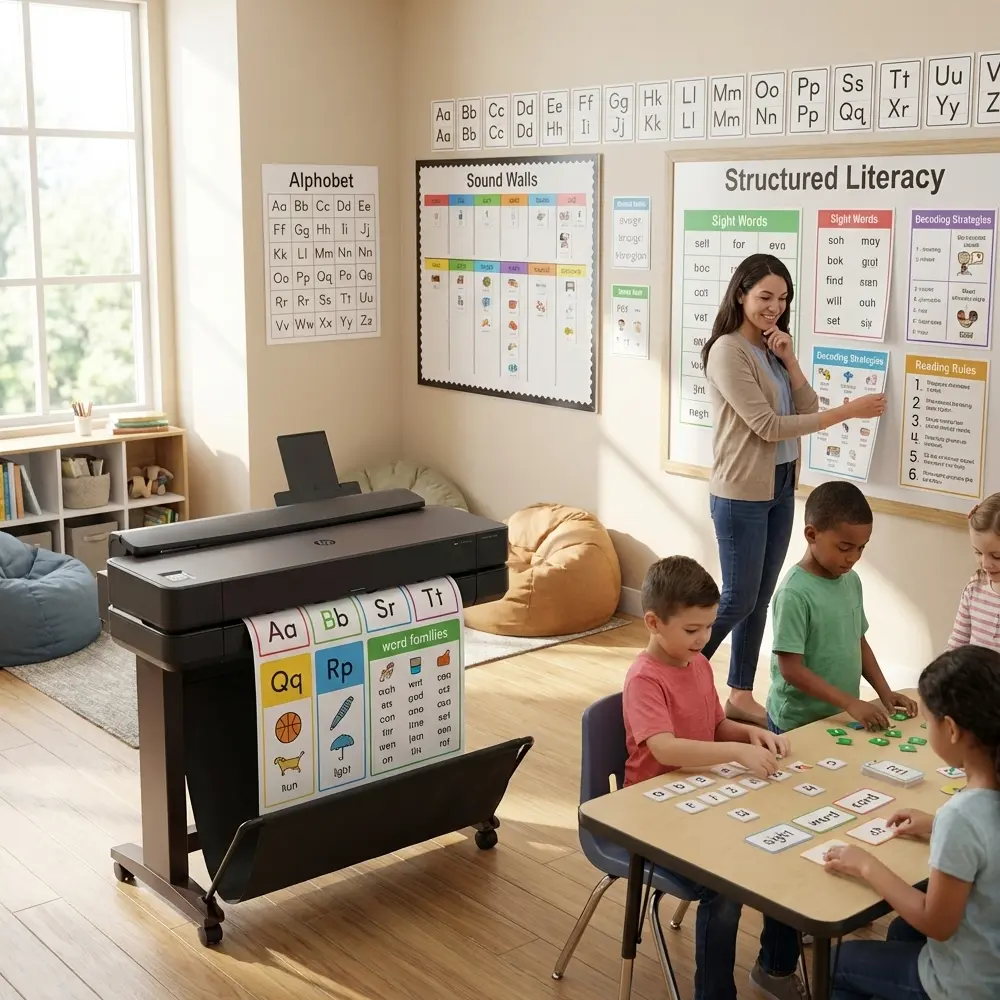
The science of reading has completely revolutionized how we teach literacy, and poster printer machines for schools are becoming essential tools in this transformation. Teachers across K-12 classrooms are discovering that visual learning materials created with a school poster maker can dramatically enhance phonics instruction, vocabulary development, and reading comprehension. As we move through 2026, the connection between evidence-based reading strategies and on-demand visual support has never been stronger.
Schools implementing structured literacy programs need consistent, high-quality visual aids. A poster printer machine allows educators to create these materials instantly, responding to student needs as they arise. Instead of waiting weeks for commercial materials or spending hours with markers and poster board, teachers can now print professional displays that align perfectly with their curriculum.
Why Science of Reading Demands Better Visual Tools
The science of reading represents decades of research into how our brains actually learn to read. This isn’t about trendy teaching methods—it’s about neuroscience and cognitive psychology working together. Researchers have identified five core components: phonemic awareness, phonics, fluency, vocabulary, and comprehension. Each component requires explicit instruction with plenty of visual reinforcement.
Traditional teaching methods often relied on generic posters purchased years ago. These materials rarely matched the specific scope and sequence of modern structured literacy programs. Teachers found themselves improvising or skipping visual supports entirely. The result? Students missed critical connections between spoken and written language.
Enter the poster maker for schools. These machines empower educators to create targeted visuals that match their exact lesson plans. When teaching the “magic e” pattern, teachers can print a vibrant poster featuring words their students actually struggle with. When introducing Greek roots, they can design displays that connect to texts students are currently reading.
The International Literacy Association emphasizes that effective literacy instruction requires flexible, responsive teaching. Having poster printer machines available means teachers can adapt their classroom environment daily. This flexibility directly supports the structured, systematic approach that science of reading demands.
Creating Phonics Displays That Actually Work
Phonics instruction forms the foundation of science of reading approaches. Students need to see letter-sound relationships repeatedly and in varied contexts. A school poster maker becomes invaluable here because phonics progression happens quickly. What works for first-graders in September won’t serve them by October.
Teachers using equipment from School Poster Makers report creating new phonics charts weekly. These aren’t generic alphabet posters gathering dust in corners. Instead, they’re dynamic displays featuring the specific patterns students are mastering right now. One week might focus on consonant blends, the next on vowel teams.
Designing Effective Phonics Posters
The visual design of phonics materials matters tremendously. Research published by the National Center on Improving Literacy shows that cluttered, overly decorative materials can actually hinder learning. Students with dyslexia particularly benefit from clean, organized displays.
A quality poster printer machine for schools produces crisp text and bold colors that support learning rather than distract from it. Teachers should include just three to five examples per poster, using consistent fonts and plenty of white space. When students can quickly reference the information they need, their working memory stays focused on decoding rather than searching for visual information.
Many educators create interactive phonics displays by printing multiple components. A base poster might show the target pattern, while laminated cards printed on the same machine allow students to practice word building. This layered approach, easily achievable with the Classroom Pro Series, transforms static posters into engaging learning tools.
Vocabulary Development Through Visual Word Walls
Vocabulary instruction has evolved dramatically with science of reading research. We now understand that students need multiple exposures to words in meaningful contexts. Simply listing definitions doesn’t build the deep word knowledge that proficient readers possess. Visual word walls created with poster printer machines bridge this gap beautifully.
Teachers can design tiered vocabulary displays that grow throughout units of study. A third-grade teacher studying ecosystems might start with basic terms like “habitat” and “prey,” then add more complex vocabulary like “symbiosis” and “biodiversity.” Each term includes not just a definition but also images, example sentences, and connections to other words.
The Reading Rockets organization emphasizes that vocabulary instruction should be active and engaging. When students see new words displayed prominently in their environment, they’re more likely to use those words in their own writing and speaking. A school poster maker makes this constant updating feasible without consuming teachers’ precious planning time.
Building Morphology Walls
Morphology—the study of word parts—represents a powerful vocabulary strategy aligned with science of reading. Students who understand prefixes, suffixes, and root words can decode thousands of unfamiliar words independently. Creating morphology walls with a poster printer machine for schools provides ongoing visual support for this crucial skill.
Teachers print large, colorful displays showing common prefixes like “un-,” “re-,” and “pre-” along with multiple example words. As students encounter new vocabulary, they add words to the appropriate sections. This collaborative process, supported by quickly printed additions, reinforces the patterns repeatedly.
A middle school might create Greek and Latin root word displays that span entire hallways. With Campus Pro Series equipment, schools can produce consistent, professional displays building-wide. Students see these patterns everywhere, making the connections automatic over time.
Supporting Reading Fluency With Visual Cues
Fluency doesn’t mean reading fast—it means reading with accuracy, appropriate speed, and expression. Science of reading research shows that fluency develops through repeated practice with appropriately challenging texts. Visual supports printed with poster maker for schools equipment help students remember prosody strategies and self-monitoring techniques.
Many teachers create fluency anchor charts showing punctuation marks and how they should sound when read aloud. These charts include visual representations: periods might have stop signs, commas show pause symbols, and exclamation points burst with excitement. Students reference these posters during independent reading and partner read-alouds.
Expression guides represent another powerful application. A poster printer machine allows teachers to print enlarged passages marked with annotation symbols. Students see exactly where to slow down, emphasize words, or change their tone. These marked-up texts, when displayed prominently, become models for students’ own reading practices.
Phrase Boundary Training Tools
Breaking text into meaningful phrases improves both comprehension and fluency. Teachers create posters demonstrating how proficient readers chunk text naturally. Using a school poster maker, they print sentences with phrase boundaries marked by slashes or different colors.
Elementary teachers might display simple sentences: “The big brown dog / ran quickly / to the park.” Upper elementary and middle school versions show more complex sentence structures. Students practice reading these displayed sentences during morning meetings or transitions, building the automaticity that fluent reading requires.
The ability to create these materials on-demand matters because texts should match students’ current reading levels. What helps struggling fifth-graders differs dramatically from what second-graders need. Having poster printer machines for schools means every teacher can produce grade-appropriate, scientifically-based fluency supports exactly when students need them.
Comprehension Strategy Displays That Guide Thinking
Reading comprehension represents the ultimate goal of literacy instruction. Science of reading emphasizes explicit strategy instruction: students need to learn how to visualize, make inferences, determine importance, and synthesize information. Visual anchor charts created with a poster printer machine for schools make these invisible thinking processes visible and concrete.
Expert teachers know that comprehension strategies shouldn’t be taught in isolation. Instead, displays show how multiple strategies work together during reading. A school poster maker enables creation of complex, layered posters that demonstrate this integrated approach. One section might show questioning techniques, another visualizing strategies, with arrows connecting them to show relationships.
The What Works Clearinghouse recommends explicit comprehension strategy instruction starting in early elementary grades. Visual reminders help students remember to apply strategies independently. When a fourth-grader forgets to monitor for understanding, a glance at the classroom poster might prompt self-correction before misconceptions deepen.
Making Metacognition Visible
Metacognition—thinking about thinking—separates proficient readers from struggling ones. Students need to recognize when they’re confused and know strategies to repair comprehension. Posters printed with poster printer machines can display fix-up strategies in student-friendly language with visual examples.
Teachers might create “When I Get Stuck” displays showing concrete actions: reread the sentence, look at pictures for clues, break unknown words into parts, or read ahead for context. Including actual text examples makes these strategies concrete rather than abstract.
Comprehension monitoring checklists represent another valuable tool. After reading each chapter or section, students can reference a displayed checklist asking: “Can I summarize what happened? Do I understand why characters acted this way? What questions do I still have?” These posters, easily updated with a school poster maker, evolve as students develop more sophisticated monitoring skills.
Differentiating Instruction With On-Demand Printing
Science of reading doesn’t mean one-size-fits-all instruction. While the core principles remain constant, teachers must differentiate based on student needs. This is where poster maker for schools technology truly shines. Teachers can create multiple versions of displays targeting different skill levels, all from the same classroom equipment.
A kindergarten teacher might print large letter-sound cards for students just learning phonics, while simultaneously creating more complex word family posters for advanced readers. Both sets of materials support science of reading principles, just at different developmental levels. Having a reliable poster printer machine means no student lacks appropriate visual support.
Many schools adopting structured literacy programs discover they need intervention materials constantly. Students requiring additional support benefit from extra visual reminders, modified anchor charts, and personalized reference materials. Rather than purchasing expensive pre-made products, teachers use their poster printing equipment to create exactly what each learner needs.
Creating Multilingual Literacy Displays
English learners acquiring literacy skills need supports in both their home language and English. Research shows that literacy skills transfer between languages, making multilingual displays particularly powerful. A school poster maker allows teachers to create side-by-side comparisons showing similar concepts in multiple languages.
Phonics patterns that exist in Spanish and English can be displayed together, helping students make connections. Cognates—words that look and sound similar across languages—make excellent poster topics. Students see that their home language knowledge supports English literacy development, building confidence alongside skills.
Schools with diverse populations might create rotating displays celebrating literacy across languages. With the quick turnaround offered by quality poster printer machines for schools, teachers can update these displays monthly or even weekly. This responsiveness shows students that all languages have value while supporting science of reading goals.
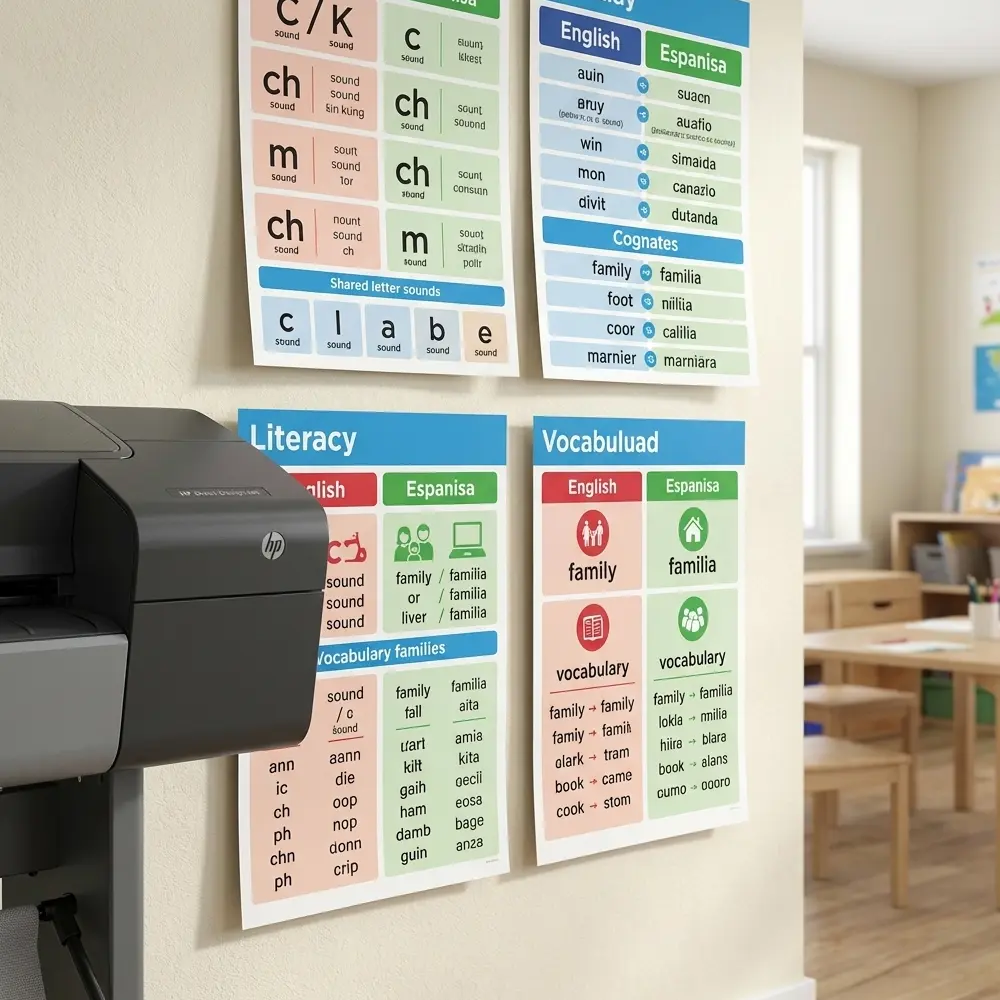
Multilingual literacy posters display shared phonics patterns and vocabulary in English and Spanish to support reading instruction.
Understanding the Cost-Effectiveness of In-House Printing
Budget-conscious administrators appreciate that poster printer machines represent smart investments for schools committed to science of reading. While the initial equipment cost requires consideration, the per-print cost and long-term savings make these machines incredibly economical. Schools can learn more about cost per print calculations to understand the true value.
Commercial educational posters typically cost $10-30 each. Schools implementing comprehensive structured literacy programs might need dozens of new displays monthly. Even at the lower estimate, that’s $100-300 monthly just for classroom materials. A quality school poster maker pays for itself within months while providing far more targeted, relevant materials.
The flexibility matters tremendously. When schools purchase pre-made posters, they’re locked into whatever the publisher designed. Maybe the color scheme doesn’t match classroom décor, or the examples don’t align with your curriculum. Maybe the reading level doesn’t suit your students. With your own poster printer machine for schools, you control every aspect of design and content.
Calculating Long-Term Savings
Smart schools look beyond initial purchase prices to total cost of ownership. When evaluating School Poster Maker packages, consider how many materials you currently purchase externally. Add the hours teachers spend creating handmade displays. Factor in the educational impact of having perfect materials immediately available.
Many districts report that a single poster printer machine serves an entire elementary school. Teachers share the equipment, creating materials during planning periods. The collaboration often improves teaching quality as educators share successful designs and strategies. This professional development benefit, though harder to quantify, represents real value.
Maintenance costs remain minimal with quality equipment. Regular ink and paper purchases constitute the primary ongoing expense. Schools should explore product options to find machines matching their volume needs. Higher-use schools might choose more robust models, while smaller sites might select compact versions.
Training Teachers to Maximize Poster Printing Technology
Having equipment doesn’t automatically translate to effective use. Schools need training plans helping teachers understand both the science of reading principles and how poster printer machines support those principles. Professional development should address visual design basics, copyright considerations, and quick-printing workflows.
Many teachers lack graphic design experience. They need guidance creating visually effective materials that support rather than overwhelm learning. Training might cover color theory basics, font selection, appropriate image use, and layout principles. These skills, once developed, benefit every aspect of classroom communication beyond literacy instruction.
The Orton-Gillingham Academy and similar organizations offer resources about structured literacy implementation. Combining this content expertise with practical training on your specific school poster maker model ensures teachers can immediately apply new knowledge. Schools should consider contacting School Poster Makers about training options supporting their specific equipment and goals.
Building a Shared Resource Library
Smart schools create digital libraries of templates and designs that teachers can quickly customize and print. A master science of reading poster collection might include phonics scope and sequence charts, high-frequency word lists, morphology examples, and comprehension strategy anchors. Individual teachers adapt these templates for their specific students.
This collaborative approach dramatically reduces the time investment required. Rather than starting from scratch, teachers access proven designs through shared drives. They modify text, adjust colors to match their rooms, and print within minutes. The poster printer machine for schools becomes a tool for efficiency rather than an added burden.
Consider establishing a school design team that meets monthly. This group creates new templates based on upcoming curriculum needs, seasonal themes, or assessment data. Other teachers benefit from this expertise while the design team members develop valuable skills. Everyone wins when schools approach their poster maker for schools strategically rather than haphazardly.
Real-World Success Stories From Science of Reading Classrooms
Elementary schools nationwide are documenting impressive results when combining science of reading instruction with strategic visual supports. One Texas district implemented structured literacy while equipping each campus with poster printer machines. Their third-grade reading scores jumped 12 percentage points in just two years, with teachers crediting the ability to create targeted visual aids as a key factor.
A Michigan elementary school serving predominantly low-income students faced persistent reading challenges. After adopting science of reading principles and installing a school poster maker in their literacy intervention space, they saw remarkable changes. Students receiving intervention showed accelerated growth, with many exiting support services entirely. Teachers noted that having immediate access to appropriate visual materials made instruction more effective and engaging.
Middle schools report benefits too, particularly for struggling readers who missed early phonics instruction. A California middle school created a structured literacy program for sixth-graders reading below grade level. Using their poster printer machine for schools, teachers built phonics and morphology supports matching middle-grade content. Students progressed an average of 1.5 grade levels annually, finally accessing grade-appropriate texts.
Data Supporting Visual Learning in Literacy
Research consistently shows that multi-sensory instruction accelerates literacy development. Visual supports represent one critical sensory channel. When students simultaneously hear phonics patterns, see them displayed, and practice writing them, neural pathways strengthen more quickly than with auditory instruction alone.
The graph below illustrates how schools with comprehensive visual support systems achieve faster student progress in core reading skills compared to schools using traditional approaches:
Reading Skills Growth: Visual Support vs. Traditional Instruction
Data Source: Composite analysis of K-5 reading assessment results from schools implementing science of reading with comprehensive visual support systems compared to traditional instruction methods (2024-2025 academic year). Percentages represent students meeting grade-level benchmarks.
This data demonstrates why forward-thinking schools invest in poster printer machines for schools. The visual component isn’t supplementary—it’s essential to maximizing science of reading effectiveness.
Choosing the Right Poster Printing Equipment
Not all poster maker for schools equipment performs equally. Schools should evaluate several factors before purchasing. Print quality matters tremendously since students will reference these materials daily. Blurry text or faded colors reduce effectiveness and frustrate both teachers and learners.
Speed represents another consideration. Teachers don’t have hours to wait for printing. The best poster printer machines produce full-size materials in minutes. During planning periods or before school, teachers should be able to design, print, and display new materials without stress. Schools can explore which poster maker is right for them through careful needs assessment.
Support and reliability shouldn’t be overlooked. Equipment sitting broken for weeks helps nobody. Choose companies offering strong warranties, responsive customer service, and readily available replacement parts. School Poster Makers specializes in educational environments, understanding unique school needs and timelines.
Key Features for Science of Reading Applications
Teachers creating science of reading materials need equipment handling diverse projects. Look for machines printing various sizes, from small word cards to wall-spanning displays. Color capabilities matter since research shows strategic color use enhances learning and memory.
User-friendliness can’t be overstated. Teachers aren’t graphic design experts with hours for technical troubleshooting. The best school poster maker systems feature intuitive interfaces allowing anyone to produce professional materials. Schools might review frequently asked questions to understand common usage scenarios and support needs.
Consider connectivity options too. Modern poster printer machines for schools should connect to school networks, allowing teachers to print from their classrooms or planning spaces. Cloud-based design tools add convenience, letting educators work on materials at home and print upon arriving at school.
Implementation Timeline for Maximum Impact
Schools shouldn’t expect overnight transformation. Successfully integrating poster printer machines with science of reading instruction requires thoughtful planning. A realistic implementation timeline spans several months, allowing for teacher training, workflow development, and continuous improvement.
Month 1: Foundation Building
Begin with equipment installation and basic training. Teachers learn machine operation, design fundamentals, and copyright compliance. Meanwhile, literacy teams identify the most critical visual supports needed schoolwide. This planning prevents duplication and ensures systematic coverage of essential concepts.
Months 2-3: Initial Creation and Refinement
Teachers start producing materials for their immediate instructional needs. Phonics teachers might focus on letter-sound cards and pattern posters. Upper-grade teachers might emphasize morphology and comprehension strategy displays. Regular check-ins help identify challenges and share early successes.
Months 4-6: Expansion and Systematization
As comfort grows, teachers tackle more ambitious projects. They create coordinated displays spanning multiple classrooms or grade levels. The shared template library expands. Schools begin documenting student achievement data to assess the impact of enhanced visual supports.
Schools ready to begin this journey should request a quote to understand equipment options matching their specific needs and budget parameters.
Maintaining Momentum and Avoiding Common Pitfalls
Schools sometimes purchase equipment that eventually gathers dust. Preventing this requires intentional leadership and accountability structures. Designate technology champions at each grade level who encourage colleagues, troubleshoot issues, and celebrate innovative applications.
Schedule regular “poster share” sessions where teachers display their latest creations. This showcases possibilities while preventing reinventing the wheel. When a first-grade teacher develops an excellent vowel team poster, why should every other first-grade teacher recreate it? Smart sharing maximizes the school poster maker investment.
Addressing Technical Challenges Proactively
Even reliable equipment occasionally experiences problems. Establish clear protocols for reporting issues and securing substitute materials during downtime. Maintain adequate supply inventories so running out of ink or paper never stalls instruction. Understanding why to choose School Poster Makers can help schools select partners committed to long-term support.
Budget for ongoing training as staff turns over. New teachers need orientation to both science of reading principles and available equipment. This continuity ensures that institutional knowledge doesn’t vanish when experienced educators retire or transfer.
Consider creating a dedicated workspace near the poster printer machine for schools. Include design resources, laminating equipment, cutting tools, and organizational systems. This “creation station” approach makes the entire process more efficient and appealing.
The Future of Visual Learning in Literacy Instruction
Science of reading isn’t a passing trend—it represents a fundamental shift in literacy education. As research continues revealing how brains learn to read, visual supports will only grow more sophisticated and essential. Schools investing in quality poster printer machines today position themselves for ongoing success.
Emerging technologies like augmented reality might eventually complement traditional posters, but printed materials will remain crucial. Not every school can afford cutting-edge technology for every classroom. A reliable school poster maker provides high-impact support at sustainable costs for years to come.
The emphasis on evidence-based practice means schools must demonstrate that their investments improve student outcomes. Having a poster printer machine for schools allows educators to create exactly the materials research recommends, rather than approximating with whatever commercial products exist. This precision matters when accountability standards continue rising.
Teachers deserve tools matching their expertise and dedication. When passionate educators understand science of reading but lack the materials to implement it effectively, everyone loses. A quality poster maker for schools removes that barrier, empowering teachers to translate their knowledge into student success.
Schools committed to literacy excellence in 2026 and beyond should explore how School Poster Makers can support their science of reading implementation. The combination of evidence-based instruction and strategic visual supports creates powerful learning environments where all students can thrive.