

Best Math Posters Created with School Poster Makers
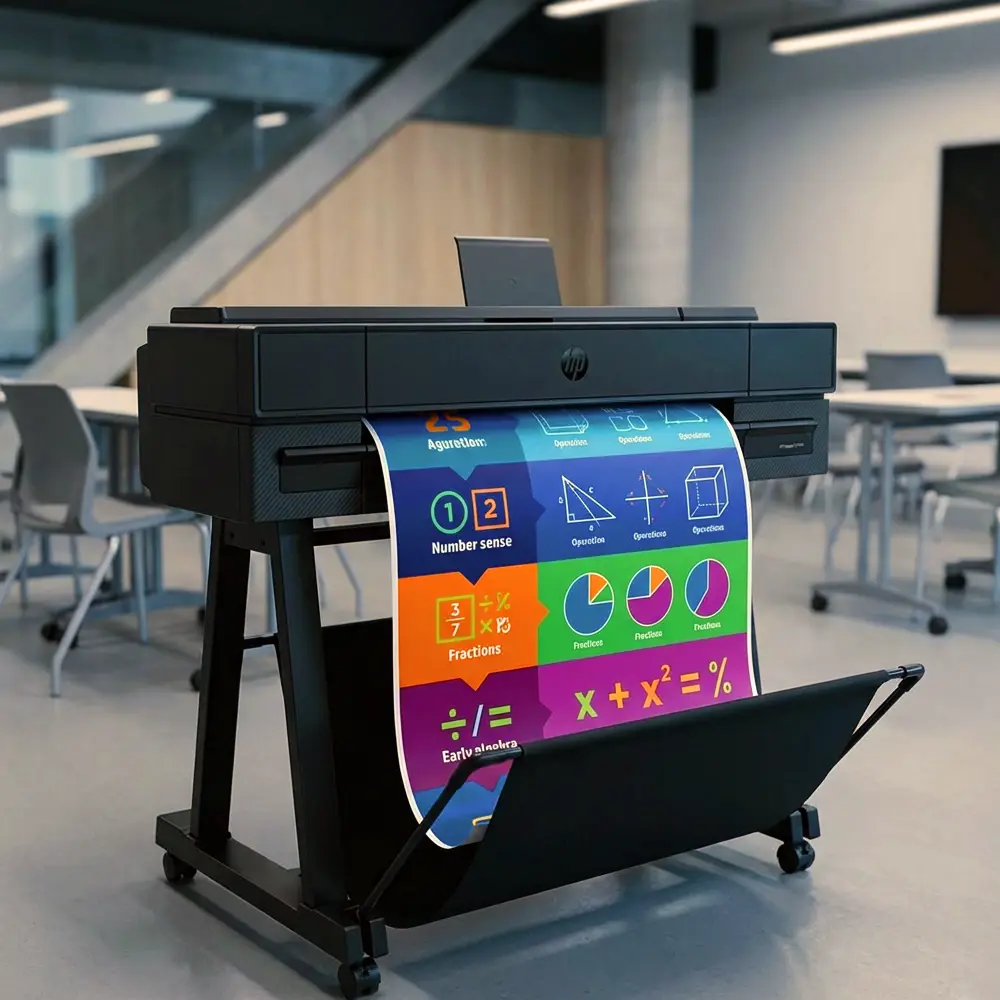
Mathematics instruction has transformed dramatically over recent years, and the best math posters created with school poster makers provide essential visual support helping K-8 students master complex concepts. From number sense fundamentals in kindergarten through algebraic thinking in eighth grade, strategically designed visual displays make abstract mathematical ideas concrete and accessible. Teachers equipped with a poster printer machine for schools can create targeted, grade-appropriate materials responding instantly to student needs rather than relying on generic commercial posters gathering dust in storage closets.
The right math posters transform classroom environments from ordinary to extraordinary. Students surrounded by clear visual references develop deeper conceptual understanding while building computational fluency. When teachers use a school poster maker to produce customized displays, they ensure perfect alignment with their specific curriculum, pacing, and student population. This customization makes all the difference between posters students ignore and displays they actually reference during independent work.
Why Visual Math Support Matters Across Grade Levels
Research consistently demonstrates that visual learning dramatically enhances mathematical understanding. The National Council of Teachers of Mathematics emphasizes that multiple representations—visual, numerical, and symbolic—help students develop flexible mathematical thinking. Posters created with poster printer machines for schools provide constant visual reinforcement of key concepts, strategies, and procedures that students encounter daily.
Elementary students particularly benefit from visual math supports as they build foundational understanding. Abstract concepts like place value, fractions, and multiplication become concrete when represented visually. Middle school learners transitioning to more sophisticated mathematics continue needing visual anchors connecting new learning to established knowledge. A quality poster maker for schools enables teachers to create developmentally appropriate displays for every grade level.
Mathematical anxiety affects countless students, sometimes beginning in early elementary years. Clear, accessible visual references reduce anxiety by providing reliable support when students feel stuck. Instead of panicking when they forget a strategy, students glance at classroom posters reminding them of multiple solution pathways. This safety net builds confidence alongside mathematical competence.
Essential Number Sense Posters for Primary Grades
Kindergarten through second grade classrooms need visual displays building number sense foundations. Number lines showing quantities from 0-20, then extending to 100, help young learners visualize numerical relationships. Teachers using their school poster maker can create number lines with visual representations matching their curriculum—dots, ten frames, or manipulative images that students recognize from hands-on activities.
Anchor charts showing different ways to represent numbers prove invaluable. A poster displaying the number 15 as tally marks, ten frames, base-ten blocks, and an equation (10+5) helps students understand that numbers exist independently of any single representation. Creating these multi-representational posters with a poster printer machine ensures they match the specific manipulatives and visual models used in your classroom.
Counting patterns deserve prominent display in primary classrooms. Posters showing counting by 2s, 5s, and 10s with visual patterns help students recognize numerical relationships foundational for multiplication understanding later. Color-coding different skip-counting sequences helps visual learners distinguish patterns quickly. The flexibility of having your own poster printer machines for schools means updating displays as students master concepts and need new challenges.
Subitizing and Quantity Recognition Displays
Subitizing—instantly recognizing quantities without counting—represents a critical early math skill. Create posters showing various dot arrangements for numbers 1-10 using different configurations. Students learn to recognize quantities in multiple arrangements, developing flexibility in numerical thinking. Include both standard dice patterns and less common arrangements so students don’t become dependent on single representations.
Ten frame posters provide powerful visual tools for developing number sense and basic addition/subtraction strategies. Display multiple ways to show each number from 1-10 using ten frames. Students begin seeing relationships like “8 is 2 less than 10” visually, building foundations for mental math strategies. Teachers can quickly print updated versions with their school poster makers as instructional focus shifts throughout the year.
Place Value Posters That Build Deep Understanding
Place value understanding separates students who truly grasp mathematics from those merely memorizing procedures. Effective place value posters show the relationship between ones, tens, and hundreds using multiple visual models. Base-ten blocks, place value charts, and expanded notation displays help students understand that 347 means 3 hundreds, 4 tens, and 7 ones—not just three random digits arranged together.
Create posters comparing numbers in standard form, expanded form, and word form. Students need repeated exposure seeing numbers represented multiple ways before truly internalizing place value concepts. A poster maker for schools allows teachers to create examples using numbers students currently struggle with rather than generic examples that might not address specific class needs.
Upper elementary students benefit from place value posters extending into decimals. Visual displays showing the relationship between ones, tenths, and hundredths using base-ten models help students grasp that decimals follow the same patterns as whole numbers. Many fifth and sixth graders struggle with decimals because they view them as completely different from whole numbers rather than extensions of the same place value system.
Rounding and Estimation Visual Guides
Rounding confuses many students because they memorize rules without understanding underlying concepts. Posters showing number lines with rounding benchmarks provide visual support helping students see why 47 rounds to 50 but 43 rounds to 40. Include both horizontal and vertical number lines since different visual orientations help different learners.
Estimation strategy posters teach students that estimation isn’t just random guessing—it’s strategic thinking about reasonable answers. Display different estimation strategies like front-end estimation, compatible numbers, and rounding, with worked examples showing when each strategy works best. Teachers using equipment from School Poster Makers can create examples using numbers from current lessons, making strategies immediately applicable.
Operation Strategy Posters Supporting Computational Fluency
Addition and subtraction strategy displays should show multiple approaches rather than single algorithms. Create posters demonstrating strategies like counting on, making tens, using doubles, and decomposing numbers. When students see that 8+7 can be solved as 8+2+5 (making a ten first) or as 7+7+1 (using doubles), they develop flexibility in mathematical thinking rather than rigid dependence on finger counting.
Multiplication fact strategy posters help students master facts conceptually rather than through rote memorization alone. Display strategies like skip counting, repeated addition, using arrays, and deriving facts from known facts (if you know 5×6=30, then 6×6=31). These visual reminders help students who struggle with memorization develop alternative pathways to fact fluency.
Division presents unique challenges for many students. Posters showing division as sharing, grouping, and repeated subtraction help students understand what division actually means. Include visual models like array drawings and number lines showing division processes. Students often memorize division algorithms without understanding the operation itself—clear visual displays address this conceptual gap.
Fraction and Decimal Operation Displays
Fraction operations confuse countless students because procedures seem arbitrary without conceptual understanding. Create visual posters showing why we need common denominators for addition and subtraction using fraction strips or circles. Display multiplication of fractions with area models demonstrating why we multiply numerators and denominators. These visual explanations transform mysterious procedures into logical processes.
Decimal operation posters should emphasize connections to whole number operations. Show how decimal addition and subtraction work exactly like whole number operations when place values align properly. Display visual models proving that 0.3 × 0.4 = 0.12 makes sense, not just as memorized procedure but as logical outcome. Teachers can print updated examples using their poster printer machine for schools whenever students need additional visual support.
Geometry and Measurement Reference Posters
Geometric shape posters should move beyond simple identification to include properties and relationships. Create displays showing attributes defining different polygons, comparing triangles by angles and sides, and exploring quadrilateral families. Include real-world examples connecting abstract geometric concepts to students’ everyday experiences.
Angle posters help students distinguish acute, right, obtuse, and straight angles. Include visual examples with and without standard protractor positioning since students often only recognize angles in specific orientations. Show angles in various contexts—intersecting lines, polygons, and real-world objects—building flexible angle recognition.
Measurement conversion charts deserve prominent display in intermediate and middle grades. Students constantly need reminders about relationships between inches and feet, centimeters and meters, or cups and quarts. Rather than purchasing commercial charts that might not match your specific curriculum emphasis, create customized versions with your school poster maker highlighting the conversions students actually use most frequently in class activities.
Perimeter, Area, and Volume Visual Guides
Perimeter and area confuse many students who struggle distinguishing between these measurements. Create side-by-side comparison posters showing how perimeter measures boundary length while area measures interior space coverage. Use consistent color coding—perhaps outlining shapes in blue for perimeter and shading interiors yellow for area—helping students develop strong visual associations.
Volume and surface area posters should include three-dimensional visual representations, not just formulas. Show rectangular prisms with dimensions labeled, demonstrating how length × width × height calculates internal space. Display unfolded nets alongside three-dimensional shapes, helping students understand surface area as total exterior coverage. These visual connections make abstract formulas meaningful.
Algebraic Thinking and Pattern Recognition Displays
Even primary students engage in algebraic thinking through pattern work. Create posters showing growing patterns with visual representations, tables, and verbal descriptions. Students begin recognizing that patterns can be represented multiple ways—an essential pre-algebra understanding. Using a poster printer machine allows teachers to feature patterns students actually explored in hands-on activities, strengthening connections between concrete experiences and abstract representations.
Variable concept posters help students transition from arithmetic to algebra. Display examples showing how variables represent unknown quantities in equations and varying quantities in expressions. Include real-world contexts making variables meaningful rather than mysterious letters. Many students struggle with algebra because they never truly understood what variables represent—clear visual displays prevent this fundamental misunderstanding.
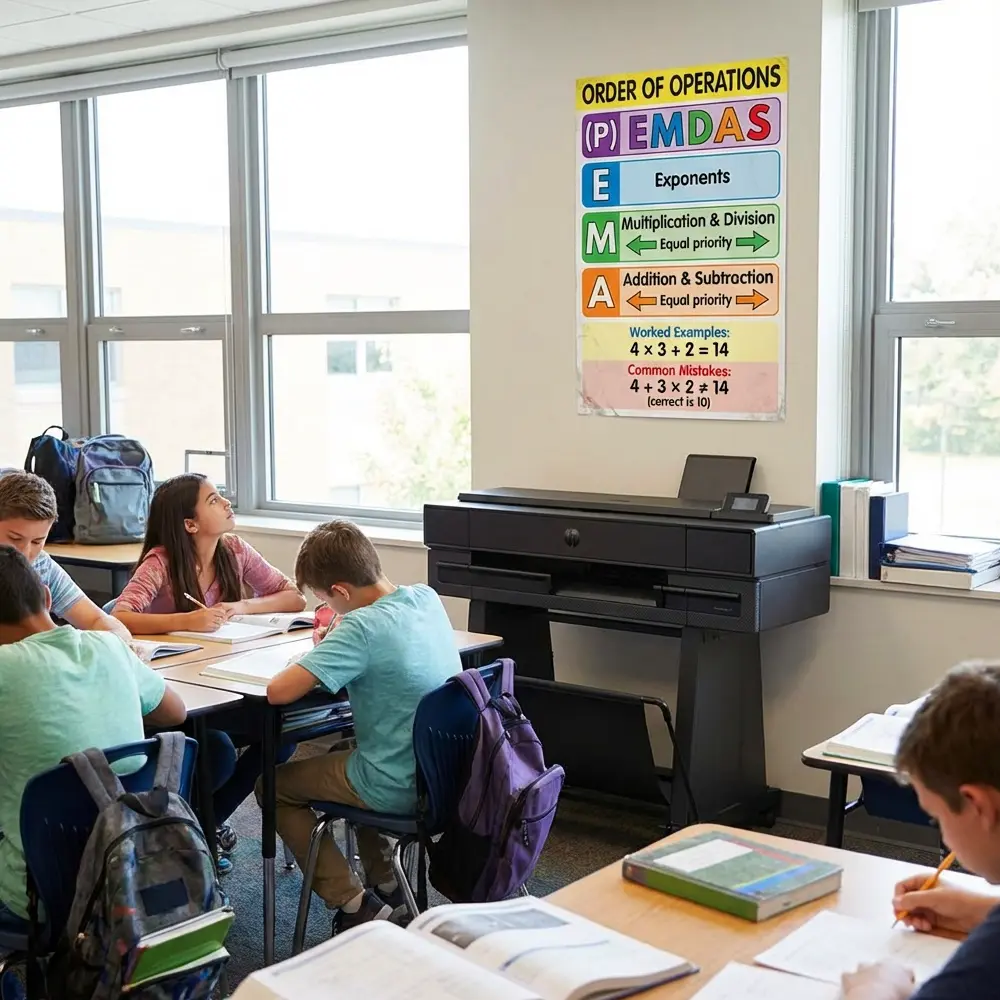
Order of operations posters prevent countless errors in middle school mathematics. Create displays using memorable acronyms like PEMDAS with visual reminders that multiplication and division have equal priority (left to right), as do addition and subtraction. Include worked examples showing common mistakes when students ignore proper operation order. These reference posters become essential tools during independent practice.
Function and Graphing Visual References
Coordinate plane posters help students navigate x and y axes confidently. Label all four quadrants clearly, with multiple plotted points in each showing positive and negative coordinate patterns. Include real-world contexts using coordinate planes, like mapping locations or graphing temperature changes over time. Contextual examples make abstract coordinate systems purposeful.
Function posters displaying input-output tables alongside graphs help students recognize relationships between different representations. Show how the same function appears in tables, graphs, and equations. This multiple representation approach, emphasized by the National Council of Teachers of Mathematics, builds deep understanding of functional relationships rather than isolated skills.
Problem-Solving Strategy Displays
Problem-solving posters should outline systematic approaches rather than suggesting mathematics involves magical insight. Display strategies like:
- Understand the problem (read carefully, identify knowns and unknowns)
- Make a plan (choose strategies like drawing diagrams, making tables, or working backwards)
- Carry out the plan (execute chosen strategies with organized work)
- Check the solution (verify answers make sense in problem context)
Include visual icons representing each step, making the process memorable and accessible for all learners. Students facing challenging problems need structure—these displays provide reliable frameworks preventing panic and random guessing.
Word problem keyword posters help students decode mathematical language, though teachers should emphasize that keywords alone don’t replace careful reading. Display common phrases like “altogether” suggesting addition, “difference” indicating subtraction, “each” implying multiplication, or “shared equally” signaling division. Include warnings that keywords provide clues, not guarantees, since context always matters most.
Mathematical Vocabulary Development Displays
Mathematics contains specialized vocabulary that many students find intimidating. Create word walls displaying current unit vocabulary with definitions, visual representations, and example usage. Unlike permanent commercial posters showing hundreds of terms overwhelming students, focused displays created with your poster maker for schools highlight the specific 10-15 terms students currently need.
Cognate posters benefit English learners tremendously. Many mathematical terms share roots across languages—”multiplication” and “multiplicación,” “fraction” and “fracción.” Display these connections explicitly, validating students’ home languages while building English mathematical vocabulary. Bilingual displays demonstrate that mathematical knowledge transfers across languages.
Prefix and suffix posters help students decode mathematical terminology independently. Display common roots like “poly” (many), “tri” (three), “quad” (four), and “deca” (ten), with examples showing how these parts create mathematical terms. Students who understand word parts navigate mathematical language more confidently than those treating every term as isolated vocabulary.
Data and Statistics Visual References
Graph type comparison posters help students select appropriate representations for different data sets. Display examples of bar graphs, line graphs, circle graphs, and pictographs alongside descriptions of when each works best. Students often default to familiar graph types rather than choosing representations matching data characteristics—these visual guides promote thoughtful selection.
Measures of central tendency posters clarify distinctions between mean, median, and mode. Include visual representations showing how each measure describes data differently. Display scenarios where different measures provide more useful information, helping students understand that statistics involves choosing appropriate tools rather than applying single formulas universally.
The visual below illustrates the impact of mathematical poster displays on student achievement and confidence:
Impact of Math Visual Displays on K–8 Student Outcomes
Quick metrics and confidence growth from classrooms using comprehensive visual math supports.
Student Math Confidence Growth by Grade Band
Percent of students reporting increased confidence after consistent exposure to visual math supports.
Research Summary: Data compiled from 64 K–8 classrooms implementing comprehensive visual math support systems using on-demand poster printing. Measurements compared pre- and post-implementation assessment scores, student surveys, and classroom observation data (2024–2025 academic year, n=1,847 students).
This data demonstrates why forward-thinking teachers invest in quality poster printer machines enabling responsive visual support creation matching specific student needs.
Designing Effective Math Posters
Visual clarity matters tremendously in mathematical displays. Avoid cluttered designs overwhelming students with excessive information. Focus each poster on single concepts or closely related ideas. Use consistent color coding across related posters—perhaps blue for addition strategies, red for subtraction, green for multiplication, and orange for division.
Font selection impacts readability significantly. Choose clear, simple fonts avoiding decorative styles that reduce legibility. Ensure text size allows easy reading from student desk distances—typically 6-8 feet in elementary classrooms. Test readability before finalizing designs, perhaps asking colleagues or students for feedback.
White space improves comprehension by allowing eyes to rest and preventing visual overwhelm. Don’t feel compelled to fill every inch with information. Strategic white space actually increases how much students absorb by making key information stand out. Teachers exploring equipment options should consider print sizes allowing adequate spacing in designs.
Maintaining and Updating Math Displays
Rotate posters strategically throughout the year. Displaying everything simultaneously overwhelms students and causes important information to blend into background noise. Feature current unit content prominently while archiving posters for concepts students previously mastered. Bring archived posters back during review periods or when students struggle with concepts building on earlier learning.
Lamination extends poster lifespan dramatically, especially in elementary classrooms where curious fingers constantly touch displays. Laminated posters survive years of use while maintaining visual appeal. Some teachers laminate posters then use dry-erase markers for temporary annotations during lessons—the markers wipe clean, allowing reuse in different contexts.
Student involvement in poster creation increases engagement and ownership. Consider collaborative poster projects where students create visual representations of concepts they’ve mastered. Displaying student-created posters alongside teacher-made materials validates student understanding while providing peer-accessible explanations. Having a school poster maker means easily printing student designs at professional quality.
Choosing Equipment Supporting Math Instruction
Teachers committed to excellent math instruction need reliable printing equipment creating professional displays on demand. Features to consider include print size capabilities, color quality, and ease of use. The Classroom Pro Series offers excellent options for individual classrooms, while larger schools might explore Campus Pro equipment serving multiple teachers.
Understanding cost per print helps budget appropriately for ongoing supply needs. Quality equipment initially costs more but delivers lower per-print costs over time compared to constantly purchasing commercial posters. Calculate how many posters you typically need annually, then compare long-term costs between purchasing commercial products and creating custom materials.
Schools unsure which equipment matches their needs can explore guidance on selecting appropriate models based on usage volume, space constraints, and budget parameters. The School Poster Makers team provides personalized consultations helping educators make informed decisions.
Taking Action to Transform Math Instruction
Mathematics instruction improves dramatically when students access high-quality visual supports matching their specific learning needs. Generic commercial posters rarely align perfectly with individual curriculum scope and sequence. Teachers equipped with poster printer machines for schools create exactly what students need when they need it. This responsiveness transforms teaching effectiveness while building student confidence and competence.
Schools ready to enhance math instruction through improved visual supports should begin by assessing current display quality and relevance. Identify gaps where students would benefit from additional visual references. Consider which concepts cause persistent confusion that targeted posters might address. This analysis guides initial printing priorities while demonstrating clear connections between equipment investment and instructional outcomes.
Explore available packages matching your school’s specific needs and budget. Many schools find comprehensive packages offering equipment, supplies, and training provide excellent value while simplifying implementation. Others prefer building customized solutions piece by piece. Either approach works when guided by clear understanding of instructional goals and student needs. Schools can also request detailed quotes for personalized recommendations.
Mathematical understanding develops through repeated exposure to concepts represented multiple ways. The best math posters provide this exposure constantly, making abstract ideas visible and accessible. Every student deserves classroom environments rich with visual supports helping them succeed. A quality school poster maker makes this vision achievable for every teacher committed to mathematical excellence.