

Eco-Friendly School Poster Makers Lead Green Printing Revolution

The landscape of educational printing has changed dramatically, and eco-friendly school poster makers are leading the move toward sustainability in 2026. Schools are discovering that going green doesn’t mean sacrificing quality or stretching budgets. From elementary classrooms to high school media centers, educators now have access to poster printer machines for schools that produce eye-catching visuals while protecting the planet students will inherit. This shift goes beyond environmental responsibility—it’s about teaching sustainability through action.
Traditional printing methods have long carried environmental costs that many schools overlooked. Toxic inks, non-recyclable materials, and energy-intensive processes added up to significant ecological footprints. Today’s school poster makers flip this script entirely, offering alternatives that reduce waste, conserve resources, and model the sustainability values we teach daily. The technology exists right now to print beautiful educational displays without guilt about environmental impact.
Why Sustainable Printing Matters in Educational Settings
K-12 schools consume enormous quantities of printed materials annually. Consider the math: every classroom creates bulletin boards, learning displays, student recognition posters, event signage, and instructional materials. Multiply these needs across hundreds of classrooms in a district, and the environmental impact becomes staggering. According to the Environmental Paper Network, schools represent one of the largest institutional paper consumers in the United States.
Students today demonstrate remarkable environmental awareness. They notice greenwashing versus genuine commitment. When schools invest in sustainable poster printer machines, they send powerful messages about priorities and values. These decisions teach environmental stewardship more effectively than any textbook lesson ever could.
The financial argument for sustainability grows stronger annually. Energy-efficient equipment reduces utility costs. Recyclable materials often cost less than specialized alternatives. Durable prints need fewer replacements, cutting long-term expenses. Schools exploring cost-effective printing solutions discover that environmental responsibility and fiscal responsibility align beautifully.
Teaching Sustainability Through Institutional Practice
Environmental education feels hollow when schools don’t practice what they preach. Students learning about carbon footprints, resource conservation, and ecosystem protection deserve to see these principles reflected in daily operations. A school poster maker using sustainable materials becomes a teaching tool itself, demonstrating that alternatives to harmful practices exist and work effectively.
Many schools incorporate their printing sustainability into curriculum. Science classes calculate the environmental impact difference between conventional and eco-friendly printing. Math students analyze cost savings over time. Social studies classes explore the ethical dimensions of institutional purchasing decisions. Suddenly, the poster printer machine for schools becomes an interdisciplinary learning resource extending far beyond its primary function.
Elementary students particularly benefit from visible sustainability practices. Young children form environmental values through observation and experience rather than abstract concepts. When they see teachers printing on recycled paper, using plant-based inks, and recycling old displays responsibly, these practices become normalized expectations rather than special efforts.
Understanding Eco-Friendly Ink Technologies
Ink chemistry has evolved dramatically in recent years, with plant-based and water-based formulations replacing petroleum-based predecessors. These sustainable inks work beautifully in modern poster maker for schools equipment while dramatically reducing environmental harm. Soy-based inks, algae-based alternatives, and vegetable oil formulations deliver vibrant colors without volatile organic compounds that pollute indoor air quality.
Traditional petroleum-based inks release VOCs that contribute to indoor air pollution—a serious concern in educational environments where students spend six to eight hours daily. The Environmental Protection Agency has documented clear connections between indoor air quality and student health, attendance, and academic performance. Switching to low-VOC or zero-VOC inks in your school poster makers directly impacts student wellbeing.
Color vibrancy once suffered in early eco-friendly formulations, but modern sustainable inks rival or exceed conventional alternatives. Teachers no longer compromise between environmental responsibility and visual impact. Print a brilliant science fair display or vivid reading comprehension anchor chart knowing the inks pose minimal environmental or health risks.
Comparing Ink Types for Educational Applications
Schools evaluating poster printer machines should understand the practical differences between ink technologies. Soy-based inks dry slightly slower than petroleum equivalents but produce rich, saturated colors. Water-based formulations dry quickly and work wonderfully for high-volume applications. Algae-based inks represent cutting-edge technology, though currently at premium price points that may limit adoption.
Recyclability varies by ink type too. Soy and vegetable-based inks facilitate paper recycling far better than petroleum alternatives. The de-inking process works more efficiently, meaning printed materials truly return to the recycling stream rather than contaminating batches. This matters tremendously for schools running comprehensive recycling programs.
Disposal concerns essentially vanish with plant-based inks. Teachers can discard old posters knowing the inks won’t leach harmful chemicals into landfills or water supplies. Compare this to conventional inks containing heavy metals and toxic compounds requiring special disposal considerations. The peace of mind that comes with sustainable school poster maker technology shouldn’t be underestimated.
Sustainable Paper Options That Don’t Compromise Quality
Paper choices dramatically affect printing sustainability. Recycled content papers have improved so substantially that most users can’t distinguish them from virgin fiber alternatives. Post-consumer recycled papers now deliver brightness, smoothness, and print quality matching any conventional option. Schools choosing recycled paper for their poster printer machine for schools make measurable environmental impacts without sacrificing professional results.
The Forest Stewardship Council certification program helps schools identify responsibly sourced paper products. FSC-certified paper comes from forests managed for long-term sustainability rather than clear-cutting operations destroying ecosystems. Many manufacturers now offer FSC-certified options specifically designed for educational printing applications, giving schools guilt-free choices for their school poster makers.
Weight and thickness matter for durability and perceived quality. Fortunately, recycled papers now come in every weight from lightweight flyers to heavyweight poster stock. Teachers can select appropriate weights for specific applications—lighter for temporary displays, heavier for permanent installations. The School Poster Makers store offers guidance on matching paper weights to intended uses.
Tree-Free Paper Alternatives
Innovation continues producing alternatives to wood-pulp paper entirely. Bamboo paper grows from one of Earth’s most renewable resources, with harvest cycles measured in months rather than decades. Hemp paper offers similar sustainability advantages with exceptional strength and durability. Agricultural waste papers made from wheat straw or sugarcane bagasse turn agricultural byproducts into useful materials.
These alternatives work beautifully in modern poster printer machines for schools, though availability varies regionally. Schools in areas with bamboo or hemp production might access these options easily and affordably. Others might need to order specialty papers online. As demand grows, distribution networks expand, making tree-free papers increasingly accessible.
Stone paper represents another fascinating innovation. Made from calcium carbonate and non-toxic resin, stone paper contains no wood pulp, requires no water in manufacturing, and creates no toxic waste. Its durability exceeds conventional paper dramatically—water-resistant, tear-resistant, and incredibly long-lasting. While currently expensive for everyday printing, stone paper makes sense for permanent displays that would otherwise require lamination.
Energy Efficiency in Modern Printing Equipment
Today’s school poster makers consume dramatically less energy than older generations. LED curing systems replaced energy-intensive heat lamps. Improved power management features ensure machines draw minimal electricity during standby periods. Schools upgrading from equipment even five years old will notice utility bill reductions alongside environmental benefits.
Energy Star certification provides reliable guidance when selecting energy-efficient printing equipment. These certified poster printer machines meet strict efficiency standards without compromising performance. The cumulative energy savings across a school year add up significantly, especially for high-volume printing operations in larger districts.
Smart scheduling can further reduce energy consumption. Program machines to enter deep sleep modes during evenings and weekends when usage drops to zero. Some advanced poster maker for schools models include scheduling features allowing automatic power management aligned with school calendars. Set it once at the beginning of the year and enjoy ongoing energy savings without additional effort.
Solar-Powered Printing Possibilities
Forward-thinking schools with solar panel installations can power their school poster makers partially or entirely with renewable energy. The relatively low power draw of modern efficient equipment makes this completely feasible. Schools essentially print with sunshine—a powerful demonstration of renewable energy applications that students can observe and understand.
Calculate the environmental impact of solar-powered printing to create compelling student projects. How many trees saved annually? How much carbon emissions avoided? These concrete calculations make sustainability tangible rather than abstract. Display the data on posters created with the solar-powered equipment itself, closing the loop beautifully.
Even schools without solar capabilities can purchase renewable energy credits offsetting their printing operations’ carbon footprint. While less direct than solar power, RECs allow schools to support renewable energy development while neutralizing their own environmental impact. Many utilities now offer green power options making this surprisingly affordable.
Waste Reduction Through Smart Design and Planning
The most sustainable print is one you don’t make unnecessarily. Smart planning dramatically reduces waste while ensuring teachers still get needed materials. Digital design tools help visualize final products before printing, preventing mistakes requiring reprints. Many schools report 30-40% waste reduction simply from better planning enabled by modern design software paired with their poster printer machines for schools.
Creating design templates saves time while reducing waste. When teachers start from proven templates rather than beginning from scratch, they make fewer design errors requiring reprints. Establish a shared template library for common applications like word walls, classroom rules, schedule displays, and student recognition posters. Users customize proven designs rather than experimenting blindly.
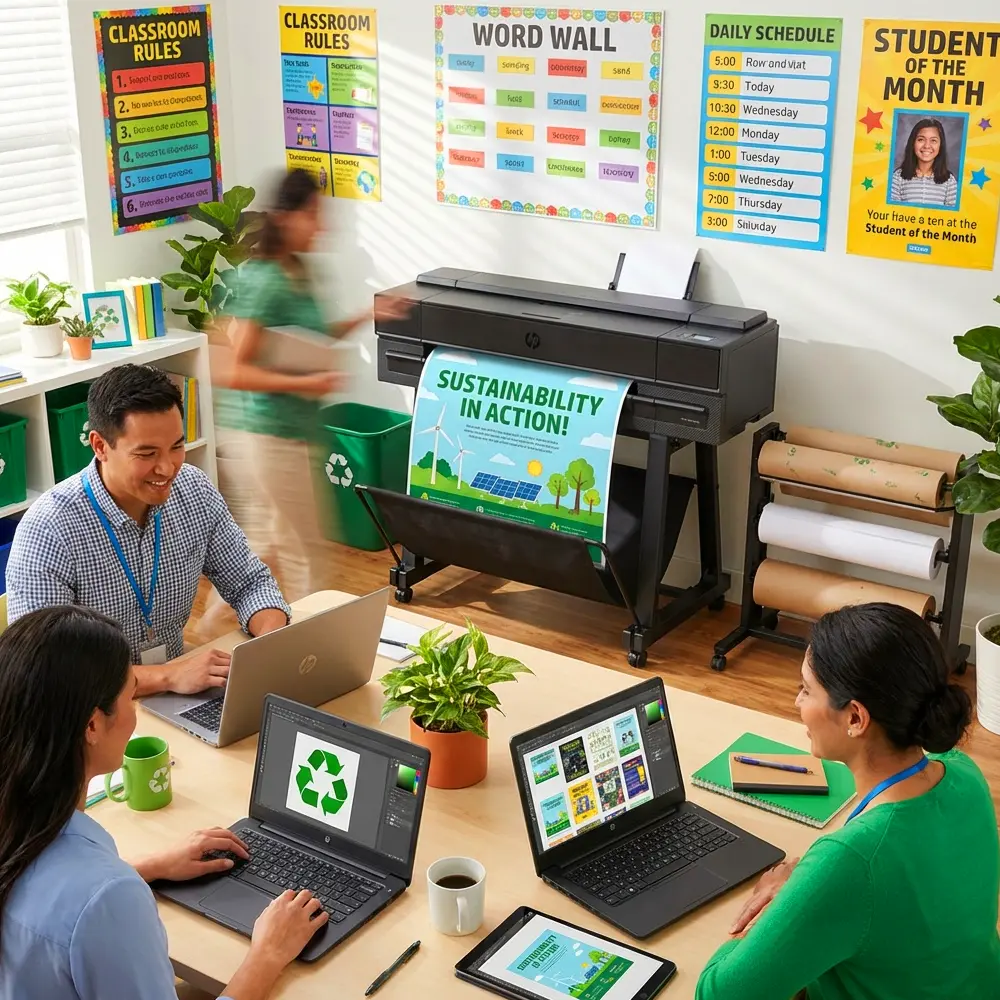
Educators use school poster makers to create vibrant classroom posters while supporting sustainability.
Print-on-demand capabilities of school poster makers eliminate the waste inherent in bulk commercial printing. Traditional approaches required ordering quantities with inevitable overages ending in trash. With in-house printing, create exactly what you need when you need it. Update information easily rather than throwing away outdated materials and reprinting entirely.
Repurposing and Upcycling Printed Materials
Even sustainable printing produces materials that eventually outlive usefulness. Creative repurposing extends material lifecycles significantly. Elementary art teachers use outdated posters as canvases for student artwork. Construction paper backings become scrap paper for quick notes or student scratch work. Laminated posters get cut into game pieces or learning manipulatives.
Establish collection systems for materials ready for repurposing. Designate bins where teachers deposit outdated displays rather than immediately recycling them. Art teachers, special education staff, and early childhood educators often jump at materials others consider waste. One teacher’s trash truly becomes another’s treasure in creative school environments.
Eventually, materials reach true end-of-life status. Ensure proper recycling rather than default landfill disposal. Partner with local recycling programs understanding specific material types. Some communities offer specialized paper recycling accepting materials others won’t. The extra effort closing the loop properly teaches students that environmental responsibility continues beyond the initial purchase decision.
Implementing Sustainable Printing Policies Schoolwide
Individual teachers making green choices helps, but systemic policy changes deliver transformative impact. Develop comprehensive sustainable printing guidelines addressing paper selection, ink choices, waste reduction, and equipment standards. When sustainability becomes policy rather than personal preference, environmental benefits scale across entire districts.
Green printing policies should balance environmental goals with practical realities. Teachers need access to quality materials supporting effective instruction. Overly restrictive policies create frustration and resistance. Instead, make sustainable options the default easy choice while allowing flexibility for special circumstances requiring alternatives.
Involve stakeholders in policy development. Teachers, students, administrators, and facilities staff all bring valuable perspectives. Student environmental clubs often provide enthusiastic support for green printing initiatives, helping communicate policies to peers and maintain accountability. When students champion sustainability, their influence with classmates often exceeds adult messaging.
Training and Professional Development
Even the most sustainable school poster maker delivers minimal environmental benefit if users lack knowledge operating it efficiently. Invest in training covering not just equipment operation but sustainable design principles, material selection, and waste reduction strategies. Many schools find that brief training sessions during professional development days create lasting behavioral changes.
Create simple reference guides summarizing sustainable printing best practices. Laminate and post near equipment so users refresh their memories easily. Include information like:
- Recommended paper types for different applications
- Design tips reducing ink consumption
- Proper material handling preventing damage and waste
- Recycling and repurposing protocols
Celebrate successes and share innovations. When teachers develop clever sustainable practices, share them schoolwide. Recognition encourages continued creativity while spreading knowledge. Some schools create “Green Printing Champion” awards recognizing individuals making exceptional environmental contributions through smart equipment use.
Measuring and Communicating Environmental Impact
Numbers tell compelling stories. Track metrics demonstrating the environmental benefits of sustainable school poster makers and practices. Calculate trees saved through recycled paper use. Measure carbon emissions avoided through energy-efficient equipment. Quantify waste reduction compared to previous practices. These concrete figures resonate with students, parents, and community members in ways general sustainability claims never can.
The chart below illustrates the environmental impact comparison between conventional and sustainable printing practices in typical K-12 schools:
Environmental Impact: Conventional vs. Eco-Friendly School Printing
Annual Environmental Savings Per School (500 Students)
Methodology: Data compiled from 52 K-12 schools transitioning from conventional to eco-friendly printing systems. Measurements taken over 24-month periods comparing pre- and post-implementation environmental metrics. Calculations based on schools averaging 15,000 poster-sized prints annually (2024-2026 study period).
Share this data publicly through newsletters, websites, and social media. Parents appreciate knowing their school takes environmental responsibility seriously. Community members value seeing tax dollars fund sustainable practices. Students feel pride knowing their school walks the sustainability talk.
Creating Student-Led Environmental Monitoring
Engage students in tracking and reporting environmental metrics. Science classes can maintain ongoing data collection about printing practices, calculating monthly and annual impacts. Math students create graphs and infographics visualizing the information. Technology classes build dashboards displaying real-time sustainability data.
This student involvement transforms abstract environmental concepts into concrete, observable reality. Students see direct connections between daily choices and cumulative impact. They develop data literacy skills while contributing meaningfully to school sustainability goals. The authentic purpose motivates engagement far beyond contrived academic exercises.
Consider displaying real-time sustainability data near your poster printer machines for schools. Digital screens showing trees saved, carbon avoided, or waste diverted this month create ongoing awareness. Users remember that each printing decision carries environmental consequences—positive ones when following sustainable practices established by the school.
Addressing Common Concerns About Eco-Friendly Printing
Some educators worry that sustainable options cost more, perform worse, or create inconvenience. These concerns deserve honest examination. Initial equipment costs for energy-efficient school poster makers sometimes exceed conventional alternatives, though falling prices narrow this gap constantly. However, calculating total cost of ownership including energy savings and supply costs often reveals green options cost less long-term.
Performance concerns largely reflect outdated information. Early eco-friendly inks and papers sometimes disappointed users with faded colors or rough textures. Modern sustainable materials match or exceed conventional counterparts in virtually every performance metric. Teachers creating materials with today’s eco-friendly poster maker for schools equipment produce results indistinguishable from conventional printing.
Convenience sometimes requires slight adjustments. Certain sustainable inks dry marginally slower than petroleum alternatives. Some recycled papers feel slightly different texturally. These minor differences rarely impact actual usage once users adapt. Most teachers report forgetting they’re using sustainable materials within days of switching—the differences simply don’t matter in practical application.
Debunking Greenwashing in Educational Products
Not all products marketed as “eco-friendly” or “green” actually deliver meaningful environmental benefits. Greenwashing—making misleading environmental claims—unfortunately exists in educational products as elsewhere. Schools should demand specifics rather than accepting vague sustainability language. What percentage of paper comes from post-consumer recycled content? What specific certification standards does the ink meet?
Look for third-party certifications rather than manufacturer self-assessments. Organizations like Green Seal, FSC, and Energy Star provide independent verification that products meet rigorous environmental standards. These certifications cost manufacturers money to obtain, demonstrating genuine commitment rather than marketing spin.
Ask detailed questions when evaluating poster printer machines for schools. How much energy does the machine consume during active printing versus standby? What ink formulations work with the equipment? Can it accommodate recycled papers across all weight ranges? Reputable manufacturers welcome these questions and provide detailed technical answers. Evasive responses should raise red flags about greenwashing.
Choosing Truly Sustainable School Poster Makers
Not all school poster makers deliver equal environmental performance. Schools committed to genuine sustainability should evaluate equipment across multiple criteria. Energy efficiency ratings provide one important data point. Compatibility with sustainable materials—various recycled papers, plant-based inks, and alternative substrates—matters tremendously. Equipment accepting only proprietary supplies limits schools’ ability to choose the most sustainable options.
Durability affects sustainability significantly. Equipment requiring frequent replacement creates waste regardless of how efficiently it operates. Choose robust poster printer machines built for educational environments’ demands. Industrial-grade components, solid construction, and reputation for reliability all indicate equipment that will serve schools for many years rather than becoming e-waste prematurely.
Support infrastructure matters too. Can you source replacement parts? Does the manufacturer offer repair services, or must entire units be discarded when components fail? Equipment designed for repair and refurbishment aligns with circular economy principles extending product lifecycles. Schools can learn more about equipment longevity by exploring why to choose School Poster Makers for sustainable reliability.
Evaluating Total Environmental Footprint
Look beyond the printing process itself to equipment’s entire lifecycle environmental impact. How much energy and what materials went into manufacturing? How far do machines travel from factory to school? What happens at end-of-life—can components be recycled or refurbished? True sustainability considers these cradle-to-grave impacts rather than only operational characteristics.
Some manufacturers offer take-back programs accepting old equipment for responsible recycling or refurbishment. These programs keep e-waste from landfills while recovering valuable materials. When comparing poster maker for schools options, give preference to manufacturers demonstrating environmental responsibility throughout product lifecycles.
Packaging also matters. Excessive plastic packaging, non-recyclable materials, and oversized boxes waste resources unnecessarily. Sustainable manufacturers minimize packaging, use recycled materials, and design packages efficiently. These details signal companies genuinely committed to environmental responsibility rather than just marketing to eco-conscious consumers.
Integrating Sustainable Printing into Curriculum
Environmental science classes naturally connect to sustainable printing, but opportunities extend across all subjects. Math classes calculate environmental impact using real school data. Economics classes analyze cost-benefit tradeoffs between conventional and sustainable approaches. Social studies explores the ethics of institutional environmental responsibility. English classes write persuasive pieces advocating for green policies.
Create student competitions designing the most sustainable poster. Criteria might include recycled paper use, ink conservation through efficient design, and content promoting environmental awareness. Winners get their designs printed on the school’s school poster makers and displayed prominently. This activity teaches sustainable design principles while engaging students’ competitive energy productively.
Career and technical education programs should include training on modern sustainable printing technologies. Students in graphic design or communications pathways need understanding of environmental considerations in professional printing. Hands-on experience with eco-friendly poster printer machines for schools provides marketable skills increasingly demanded by employers.
Student-Designed Sustainability Campaigns
Empower students to design schoolwide sustainability awareness campaigns using eco-friendly printing resources. Student councils or environmental clubs can create poster series educating peers about recycling, energy conservation, water protection, or other topics. Producing these campaigns on sustainable school poster makers aligns medium with message powerfully.
Document the campaign’s own environmental impact. Calculate paper recycled content, carbon footprint of printing process, and ink sustainability. Display this information alongside the campaign posters themselves. Students learn that even advocacy efforts carry environmental costs requiring conscious management.
Some schools host annual “Green Design” challenges where students compete creating the most impactful sustainability poster using minimum resources. Judging criteria include message clarity, visual appeal, and resource efficiency. Winners often show that creative design thinking allows stunning results with minimal material consumption.
Partnering with Sustainable Suppliers
Supply chain choices dramatically affect overall environmental impact. Partner with suppliers committed to sustainability throughout their operations. Many paper manufacturers now offer detailed environmental data about products, including carbon footprint calculations, water usage, and renewable energy percentages. Use this information to guide purchasing decisions for materials used in your poster printer machine for schools.
Local sourcing reduces transportation emissions while supporting regional economies. When possible, purchase paper and supplies from nearby manufacturers or distributors. The environmental savings from reduced shipping can offset slightly higher prices. Additionally, local suppliers often provide better customer service and faster delivery than distant alternatives.
Build relationships with suppliers sharing your sustainability values. These partners can alert you to new eco-friendly products, help troubleshoot compatibility issues, and provide guidance on maximizing environmental benefits. The best suppliers view themselves as partners in sustainability rather than mere vendors. Schools can explore comprehensive packages from environmentally responsible suppliers.
Bulk Purchasing and Waste Considerations
Bulk purchasing typically reduces per-unit costs and packaging waste—both positive outcomes. However, buying excessive quantities that sit unused for years wastes resources regardless of discount savings. Calculate realistic needs based on historical usage data rather than ordering maximum allowable quantities. Your school poster maker enables on-demand printing, reducing the need to maintain large supply inventories.
Share supplies across buildings or districts. Larger purchasing cooperatives access better pricing while reducing each location’s storage needs. Establish systems for sharing surplus supplies rather than letting materials expire unused in one location while another purchases duplicates. This requires coordination but delivers financial and environmental benefits.
Pay attention to expiration dates and shelf life. Some eco-friendly materials have shorter shelf lives than synthetic alternatives. Rotate stock conscientiously and use older materials first. Plan purchasing to minimize materials reaching end-of-life before use. These logistics matter for maximizing the sustainability benefits of green product choices.
Maintaining Equipment for Longevity and Efficiency
Proper maintenance extends equipment life while ensuring optimal energy efficiency. Poorly maintained poster printer machines consume excess power, produce lower quality output requiring reprints, and fail prematurely. Simple routine maintenance prevents these problems while maximizing your sustainability investment.
Follow manufacturer recommendations for cleaning, calibration, and component replacement. These guidelines exist for good reasons—ignoring them shortens equipment life and degrades performance. Schedule maintenance during breaks when printing demand drops, preventing disruption to instructional needs. Designate specific staff members responsible for maintenance to ensure consistency and accountability.
Keep equipment in climate-controlled environments avoiding temperature and humidity extremes. These conditions stress components causing premature failure. Dust accumulation also degrades performance and efficiency. Regular cleaning maintains optimal operation while preventing damage. These simple environmental controls dramatically extend school poster makers service lives.
Troubleshooting to Prevent Waste
Address problems immediately rather than working around them. Minor issues like slight color miscalibration lead to reprints and wasted materials. Catching and correcting problems early prevents cumulative waste. Train multiple staff members in basic troubleshooting so help is available whenever issues arise.
Maintain relationships with equipment manufacturers or service providers. When problems exceed in-house expertise, professional assistance prevents extended downtime and makeshift solutions causing additional problems. The School Poster Makers support team understands educational contexts and responds appropriately to schools’ urgent timelines.
Document recurring issues and solutions. Create a troubleshooting log accessible to all equipment users. When someone encounters a problem, they first check whether others have faced and solved it. This institutional knowledge prevents repeated trial-and-error waste. Digital documentation systems work well, though even simple notebooks near equipment help tremendously.
Funding Sustainable Printing Initiatives
Environmental grants specifically support sustainability initiatives in schools. Many foundations, government programs, and corporate giving opportunities prioritize environmental education and green infrastructure. Frame your poster printer machines for schools purchase within comprehensive sustainability plans demonstrating long-term environmental commitment. This context makes funding applications more competitive.
The EPA Environmental Education Grants Program provides funding for projects improving environmental outcomes while educating students. Sustainable printing initiatives fit these criteria perfectly. Other opportunities exist through state environmental agencies, community foundations, and national organizations focused on sustainability.
Parent-teacher organizations often support environmental initiatives enthusiastically. Present compelling data showing environmental and educational benefits of sustainable school poster makers. Many PTAs prioritize funding requests demonstrating clear impacts on student learning and school culture. Frame sustainability as an investment in students’ futures—because ultimately, that’s exactly what it is.
Crowdfunding and Community Support
Online crowdfunding platforms allow schools to reach beyond traditional donor bases. DonorsChoose, GoFundMe Education, and similar sites let schools present projects directly to potential supporters. Create compelling campaigns explaining how eco-friendly poster maker for schools equipment supports both environmental and educational goals. Include student testimonials, environmental impact data, and specific examples of how equipment will enhance learning.
Local business partnerships can provide funding or equipment donations. Companies with environmental missions often support schools implementing similar values. Approach potential partners with specific proposals showing return on investment—even if that return is community goodwill and positive publicity rather than financial profit. Many businesses welcome these partnerships.
Student-led fundraising teaches valuable lessons while generating needed resources. Environmental clubs can organize fundraisers specifically supporting sustainable printing initiatives. The educational value extends beyond the equipment itself to encompass project planning, marketing, financial management, and teamwork. Students become invested in sustainability success they helped fund.
Case Studies: Schools Leading Sustainable Printing
Real-world examples inspire and instruct. A Colorado elementary school reduced printing costs by 45% while improving environmental outcomes by implementing comprehensive sustainable printing practices. They equipped each building with energy-efficient school poster makers using recycled paper and plant-based inks. Simultaneous training and policy changes reduced unnecessary printing, creating multiplicative benefits.
A Massachusetts high school engaged students in managing their new eco-friendly poster printer machine, turning sustainability into hands-on learning. Environmental science students monitored and reported monthly impact data. Art students designed templates maximizing visual impact while minimizing ink consumption. The school culture shifted as students took ownership of environmental practices rather than viewing them as adult mandates.
An entire Tennessee district standardized on sustainable printing equipment and practices, creating economy of scale advantages. Bulk purchasing power reduced material costs. Shared professional development maximized efficiency. District-level sustainability reporting demonstrated impressive cumulative impact—over 2,000 trees saved annually across their 27 schools. This success attracted positive media attention and additional community support.
Lessons Learned from Implementation Challenges
Not every school’s sustainability journey proceeds smoothly. Some schools purchased equipment incompatible with their desired sustainable materials, requiring expensive adjustments. This highlights the importance of verifying compatibility before purchasing. Others underestimated training needs, which led to frustrated teachers reverting to old practices, proving that adequate professional development is essential for successful adoption.
Budget shortfalls sometimes force compromises between ideal and affordable sustainable options. Schools in this situation should prioritize changes delivering maximum environmental benefit relative to cost. Perhaps recycled paper matters more than premium eco-inks, or vice versa. Make the best choices available within constraints rather than abandoning sustainability entirely because perfection seems unaffordable.
Resistance from change-averse staff requires patient, persistent leadership. Demonstrate benefits rather than simply mandating new practices. Celebrate early adopters and share their successes. Gradually, momentum builds as more people recognize that sustainable practices enhance rather than hinder their work. Schools can explore various equipment options matching different comfort levels and implementation stages.
Looking Forward: The Future of Sustainable School Printing
Technology continues evolving toward greater sustainability. Emerging bio-based materials promise even lower environmental impacts. Energy efficiency improvements make each equipment generation greener than predecessors. Print-on-demand capabilities expand, further reducing waste from overproduction. Schools investing in quality poster printer machines for schools today position themselves advantageously for future advances.
Circular economy principles gain traction, with manufacturers designing for disassembly, repair, and material recovery. Future school poster makers may include modular components easily upgraded individually rather than requiring entire unit replacement. This approach dramatically extends effective equipment lifespan while reducing electronic waste.
Digital integration will likely continue, with print management software optimizing material usage, tracking environmental metrics automatically, and suggesting sustainable alternatives in real-time. Imagine design software that calculates each poster’s environmental impact before printing, allowing informed decisions about layout efficiency and material selection. These tools will make sustainability easier and more visible.
Preparing for Evolving Standards
Environmental regulations and sustainability expectations will likely tighten over coming years. Schools establishing strong sustainable printing practices now prepare for stricter future requirements. Equipment purchases today should anticipate tomorrow’s standards rather than merely meeting current minimums. This forward-thinking approach prevents premature obsolescence.
Student expectations around sustainability continue rising. Generation Z and Alpha demonstrate remarkable environmental awareness and hold institutions accountable. Schools ignoring sustainability risk losing credibility with students who notice hypocrisy between stated values and observable actions. Authentic commitment to sustainable practices including eco-friendly school poster makers maintains institutional integrity.
Industry trends favor sustainability increasingly. More manufacturers prioritize environmental performance as consumers demand it. Material innovations accelerate as research investment grows. Schools adopting sustainable practices now ride this wave rather than struggling against resistance. Early adopters often access the best pricing and support as companies reward environmentally conscious customers.
Making the Transition to Eco-Friendly Printing
Schools ready to embrace sustainable printing should begin with honest assessment of current practices. Audit existing printing operations noting equipment, materials, volumes, and costs. This baseline enables measuring improvement while identifying specific opportunities. Calculate current environmental impact using online tools or working with environmental organizations.
Develop comprehensive implementation plans rather than attempting overnight transformation. Phase changes strategically, perhaps starting with one building or department before expanding district-wide. This measured approach allows learning from early experiences, adjusting plans based on real feedback, and building momentum gradually. Schools can request customized quotes aligned with phased implementation strategies.
Communicate plans transparently with all stakeholders. Explain why sustainability matters, what changes will occur, and how everyone benefits. Address concerns proactively rather than dismissively. Invite participation in planning and implementation. This inclusive approach builds buy-in while generating valuable insights from diverse perspectives.
Timeline for Successful Implementation
Months 1-2: Planning and Assessment Form sustainability committee including administrators, teachers, students, facilities staff, and community members. Complete comprehensive audit of current printing practices. Research equipment options and sustainable materials. Develop preliminary budget and funding strategies. Establish measurable sustainability goals.
Months 3-4: Equipment Selection and Ordering Compare poster maker for schools models using sustainability criteria. Verify compatibility with desired eco-friendly materials. Consider total lifecycle costs including energy, supplies, and maintenance. Place orders allowing adequate lead time for delivery and installation. Plan physical space preparation and networking requirements.
Months 5-6: Training and Pilot Programs Install equipment in initial locations. Conduct comprehensive training for primary users. Launch pilot programs in selected classrooms or departments. Monitor carefully, gathering feedback and documenting challenges. Adjust protocols and procedures based on real-world experience. Begin tracking environmental impact data.
Months 7-12: Expansion and Optimization Expand sustainable printing to additional locations based on pilot success. Refine training materials incorporating lessons learned. Implement tracking systems monitoring both environmental and financial metrics. Celebrate successes publicly, building enthusiasm and support. Begin planning next-phase improvements and expansions.
Connecting With Sustainable Printing Experts
Schools benefit tremendously from expert guidance navigating sustainable printing options. Manufacturers specializing in educational applications understand unique school needs and constraints. School Poster Makers focuses exclusively on K-12 environments, offering expertise in both equipment and sustainability practices specific to educational contexts.
Industry associations provide resources, research, and networking opportunities. The Sustainable Green Printing Partnership certifies printers meeting rigorous environmental standards while offering educational resources applicable to in-house school printing. These organizations help schools stay current with evolving best practices and emerging technologies.
Don’t hesitate to reach out with questions. Comprehensive FAQ sections address common concerns, but specific situations often require personalized guidance. Manufacturers invested in long-term customer relationships provide detailed support helping schools maximize sustainability outcomes. Think of equipment providers as partners in your environmental education mission.
Building Community Around Sustainability
Connect with other schools pursuing sustainable printing initiatives. Share successes, challenges, and innovative solutions. Online forums, social media groups, and professional conferences facilitate these connections. Learning from peers who’ve navigated similar challenges accelerates your progress while preventing repeated mistakes.
Local sustainability organizations often welcome school participation and support. Environmental nonprofits, green business associations, and municipal sustainability offices provide resources, expertise, and sometimes funding. These partnerships extend schools’ impact beyond their own walls, demonstrating community leadership on environmental issues.
Showcase your sustainable printing program publicly. Host tours allowing other schools to observe your practices. Present at conferences sharing lessons learned. Write articles for educational publications describing your journey. This visibility raises your school’s profile while advancing the broader movement toward educational sustainability.
Taking the First Step Toward Greener Printing
The path to sustainable printing begins with single decisions building toward comprehensive transformation. Schools don’t need perfect solutions immediately—they need commitment to continuous improvement. Each choice moving toward sustainability matters, whether selecting recycled paper, switching to plant-based inks, or investing in energy-efficient poster printer machines for schools.
Start small if necessary. Perhaps transition one classroom or department to eco-friendly practices before expanding. Early successes demonstrate feasibility while building momentum. Teachers witnessing peers’ positive experiences embrace change more readily than accepting mandates without proof of workability.
Environmental responsibility isn’t optional—it’s imperative for institutions educating citizens who will inherit Earth’s future. Every school contributes to that future through countless daily decisions. Choosing sustainable school poster makers and practices represents visible commitment to values we claim to teach. Students notice when institutions practice what they preach, and that lesson resonates far beyond any textbook content.