

Making School Values Visible with Custom Posters
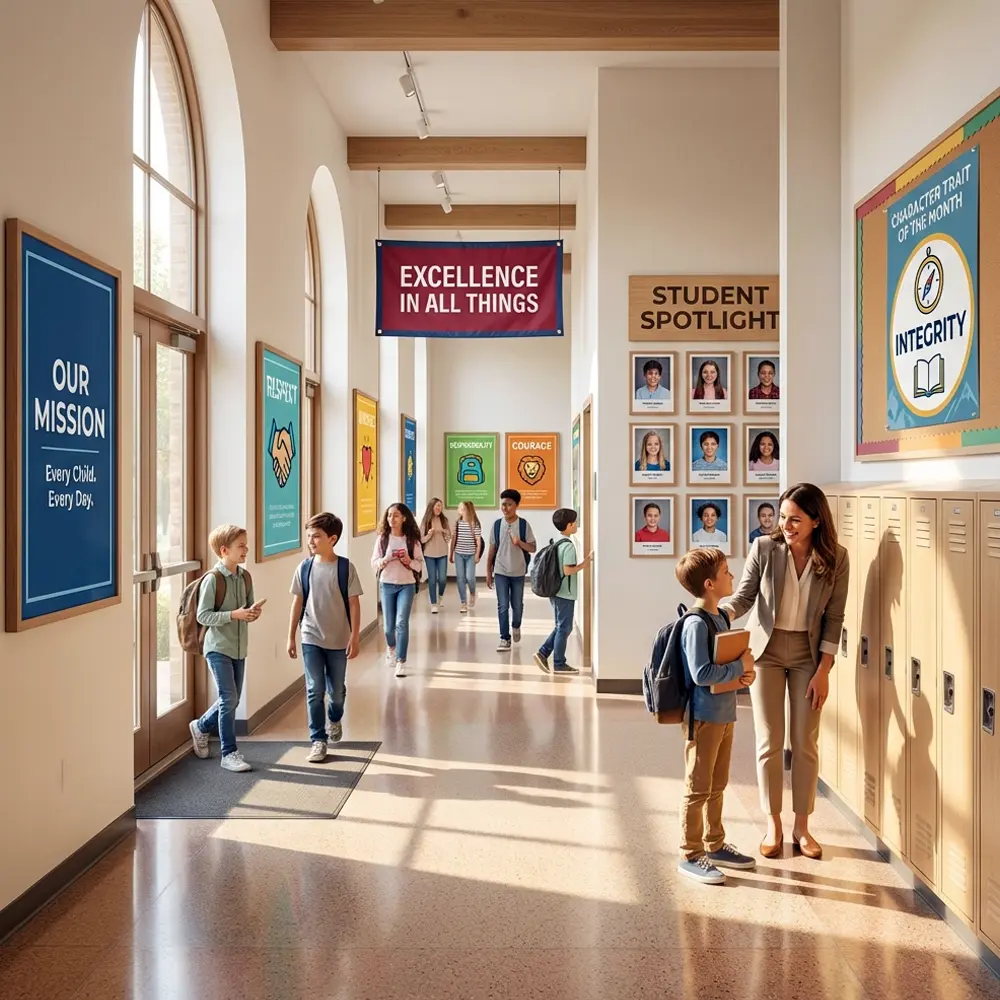
Walk into any school and you'll know its values within thirty seconds—or you won't know them at all.
That's the real test of school culture. It's not whether values exist in a handbook—rather, it's whether they exist in the hallways.
In other words, mission statements either live in the building's visual environment or they live nowhere meaningful. This gap between documented values and visible values defines whether your school culture is intentional or accidental.
After visiting hundreds of schools over two decades, I've noticed a clear pattern. The difference between buildings where values stick and buildings where they don't comes down to one thing: visibility, repeated and consistent.
Here's what typically happens with school mission statements. A committee spends months crafting the perfect words. Members debate every phrase, achieve hard-won consensus, and feel proud of the result.
Afterward, they put it on the website, mention it at orientation, and move on to the next initiative.
Yet a year later, ask a random fifth grader what the school's mission is. You'll likely get a blank stare.
This isn't the student's failure. Rather, it's an environmental design failure.
In fact, humans remember what they see repeatedly. We internalize messages that surround us. For instance, advertising works this way. Likewise, political campaigns work this way, and school culture works this way too.
Similarly, character education programs face the same visibility challenge. PBIS frameworks, virtue-based curricula, and social-emotional learning initiatives all require constant reinforcement.
Posting expectations once and expecting behavior change is magical thinking. Instead, students need to encounter character trait messages in multiple contexts. Moreover, they need formats that feel fresh rather than stale.
The practical obstacle is cost.
Unfortunately, traditional poster printing makes comprehensive school values displays expensive. For example, a single 24×36 inch print from a local shop runs $40-75.
Do you want that mission statement poster in every classroom? What about monthly character trait rotations? Or updated hallway displays for different seasons? In that case, the numbers become prohibitive quickly.
This is exactly why in-house poster production changes the conversation. When the same school values poster costs under two dollars in materials, schools can finally achieve the visual saturation that actually influences behavior.
As a result, several applications become practical:
- Mission statement displays at every entrance, in every classroom, in every common space
- Monthly character trait posters that rotate with the school calendar
- Student recognition displays updated weekly with current photos and names
- Event-specific messaging coordinated with assemblies and spirit weeks
- Multilingual versions serving diverse school communities
"Our hallways used to be decorated. Now they communicate."
— Elementary Principal, TexasAdditionally, school mottos deserve particular attention. These condensed expressions of identity work as rallying points only when students encounter them constantly.
Consider phrases like "Excellence in All Things" or "Every Child, Every Day." A motto on letterhead accomplishes nothing. However, a school motto poster visible from the gymnasium bleachers during every assembly becomes part of collective memory.
Implementation isn't complicated.
Start with a simple audit. Walk your building as a visitor would. Where are your school values displayed? Where are the gaps?
In most cases, schools discover they have far fewer visual touchpoints than they assumed.
Next, prioritize high-traffic locations. Focus on main entrances, cafeterias, the gymnasium, and major hallway intersections. Because these spaces offer maximum exposure with minimum effort, they should come first.
To illustrate, a single well-placed 36×48 inch custom poster reaches more students than a dozen smaller displays in secondary locations.
Finally, consider the refresh question. Static displays become invisible over time because the brain simply stops registering familiar stimuli.
Therefore, schools with successful values programs build rotation into their planning. Perhaps the core message stays consistent while visual treatments change seasonally. Or character trait posters cycle monthly. Above all, the key is preventing visual fatigue.
Equipment note
The Classroom Pro Series handles standard classroom and hallway displays. For gymnasium banners and larger formats, the Campus Pro Series provides wider printing capability. The equipment quiz helps match your specific volume and format needs.
Student involvement creates investment.
When students help design school values displays, they engage with the content rather than passively receiving it.
For example, this might mean interpreting the mission statement visually. Alternatively, it could involve illustrating character traits or creating motto artwork for hallway displays.
Interestingly, these student-created custom posters often resonate more powerfully than professional designs. Why? Because they represent authentic youth interpretation of school values. Indeed, research from Character Lab confirms that student engagement with character concepts deepens when learners actively participate in meaning-making.
Furthermore, parent and community perception matters. Visitors form impressions of school culture within moments of entering a building.
As a result, coordinated professional values displays communicate intentionality. They signal that this school knows what it stands for. Consequently, that impression influences enrollment decisions, community support, and staff recruitment.
The research on environmental influence is clear. Specifically, students in buildings with consistent visual reinforcement show measurably better outcomes compared to students in visually chaotic or value-neutral environments.
Of course, this isn't surprising. After all, we've known for decades that environment shapes behavior.
However, what's changed is the practical accessibility of comprehensive visual programs. Schools no longer need large print budgets to achieve professional, building-wide values displays.
As a result, the economics have shifted in favor of schools that want to make their values visible with custom posters.
Every mission statement deserves to be seen. In addition, character trait expectations deserve constant reinforcement. Similarly, school mottos deserve to become part of every student's daily visual experience.
Ultimately, the only question is whether your building will tell that story—or remain silent.
Browse poster maker packages designed for K-12 environments, or request a quote for your specific situation. Questions? Contact the School Poster Makers team.