Ph.D. Clinical Psychology, Stanford · Licensed Educational Psychologist · 12+ years in K–12
Before I was a psychologist I was a high school counselor, and I still remember the day a freshman slid into my office, sat on the floor, and said she just needed "a place that's not so loud." She didn't need a therapist that day. She needed a quiet corner. Most students—and plenty of teachers—need the same thing, and the classroom can be that place if it's set up with intention. This is how to do it.
Try it yourself first
4-7-8 Breathing
Ready?
Inhale 4, hold 7, exhale 8. The longer exhale is what activates the parasympathetic nervous system.
If you felt even slightly calmer after one round, imagine what a version of this, visible on a poster, does for a dysregulated student.
What a Calm Down Corner Actually Does (Neurologically)
A well-designed calm down corner isn't a time-out space and it isn't a reward. It's a regulation tool—a physical place in the classroom that helps a student's nervous system return to baseline so they can re-engage with learning. When a child is flooded with stress, the prefrontal cortex—the part of the brain responsible for reasoning, impulse control, and attention—literally goes offline. You can't teach, discipline, or reason with a dysregulated student. You can only help them regulate first.
The good news: regulation is a teachable skill. When students have a consistent, predictable space with clear visual supports, they learn to notice their own stress signals earlier, choose a strategy, and recover faster. Over time, the corner becomes less necessary—because the self-regulation habits have transferred.
From the research
Classrooms that integrate explicit self-regulation supports—including visual strategy tools and dedicated calming spaces—see meaningful reductions in disciplinary referrals and meaningful gains in academic engagement, particularly among students with trauma histories or neurodevelopmental differences.
— Synthesis of CASEL, Harvard Center on the Developing Child, and trauma-informed schools literature
The 5 Non-Negotiables of an Effective Calm Down Corner
I've consulted on dozens of classrooms. The ones that work all share these five elements. The ones that don't usually share a common failure: they were built around cuteness, not function.
01
A physical boundary
A bookshelf, a curtain, a rug, a tent—anything that signals "this space is different." Visual separation lowers sensory load instantly. Without a boundary, it's just another part of the classroom.
02
Visible strategy menu
A poster that shows 4–6 coping strategies, illustrated. When the prefrontal cortex is offline, students can't generate options. They need to see them.
03
Sensory tools (2–3, not 12)
Fidget, stress ball, textured pillow, noise-dampening headphones. More options means more decisions—the opposite of what a dysregulated brain needs.
04
A clear re-entry cue
A timer, a check-in card, or a signal the teacher and student agreed on. The space is for regulation, not escape—the exit plan matters as much as the entry.
05
Taught norms
Students need to practice using the corner before they need it. Model it, role-play it, and reinforce it. A corner with no norms becomes a hiding spot within a week.
The 6 Posters Every Calm Down Corner Needs
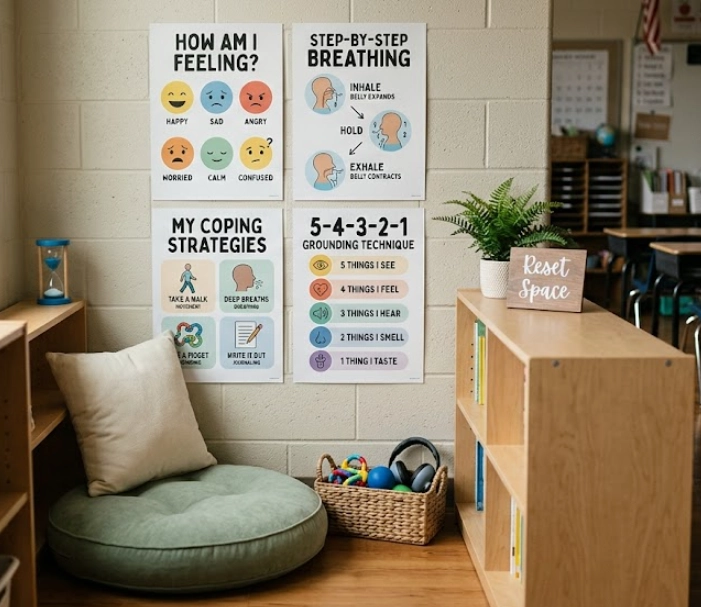
Visuals do the cognitive work that a regulating brain can't do on its own. A poster is not decoration here—it's a prosthetic for the prefrontal cortex. Printed large, at a child's eye level, they're the single highest-leverage addition you can make to a calming space. These six cover the full regulation cycle.
1
Feelings Identification Chart
A grid of facial expressions or color-coded zones that lets a student point to how they're feeling. Start here—you can't regulate an emotion you can't name.
Why it works: naming an emotion reduces amygdala activation. This is called "affect labeling" and it's one of the best-replicated findings in regulation research.
2
Breathing Exercise Visual
Step-by-step 4-7-8, square breathing, or "smell the flower, blow out the candle" for younger students. Visual pacing means students don't have to rely on an adult's voice to time it.
Why it works: paced breathing with a longer exhale is the fastest evidence-based route back to regulation.
3
Coping Strategies Menu
A visual "choose one" board: movement, sensory input, grounding, social, creative. Limit to 4–6 options to prevent decision paralysis.
Why it works: external cues scaffold executive function when internal executive function is offline.
4
5-4-3-2-1 Grounding Poster
The classic sensory-grounding technique: 5 things you see, 4 you hear, 3 you can touch, 2 you smell, 1 you taste. Particularly effective for students with anxiety or trauma histories.
Why it works: sensory focus pulls attention out of rumination and back into the present body.
5
Norms & Re-entry Poster
"In this space we: speak quietly, stay no more than 5 minutes, tell the teacher when we're ready to come back." Clear, short, positively framed.
Why it works: explicit norms reduce the ambiguity that itself causes stress.
6
Affirmation or Reset Statement
A single, grounding phrase: "Big feelings are not bad feelings." "I can feel hard things and still be okay." Keep it short, developmentally appropriate, and non-trite.
Why it works: a self-compassion cue interrupts the shame spiral that often accompanies loss of control.
A practical note on printing these
These posters need to be large enough to read from the corner—think 18×24 inches or 24×36. Standard printer paper doesn't work; students won't engage with something that looks like a handout. Schools that invest in an in-house poster maker can produce all six posters in an afternoon, swap them out as needs change through the year, and differentiate them for specific students. A repositionable fabric poster is especially useful here—you can move the whole calming corner without damaging walls or posters, which matters more than you'd think in a building that repaints every summer.
Adapting the Corner by Age
A calm down corner in a kindergarten room should look nothing like one in an eleventh-grade English classroom. The framework is the same; the execution is wildly different. Select an age band:
K–2: The "Cozy Corner"
Call it a cozy corner or peace corner—younger students associate "calm down" with punishment.
Include a stuffed animal, a soft pillow, and a small picture book about feelings.
Use picture-only posters with minimal text; feelings charts with faces and colors work best.
Practice together as a whole class. Pretend to "be upset" and walk through using the space.
Set a visual timer (sand timer, 2–5 minutes). Children this age can't track time abstractly.
3–5: Strategy Building
Students can start to articulate why they're using strategies. Let them.
Add a reflection card with 3 prompts: what was hard, what I tried, what helped.
Posters can include more text—strategy menus with 5–6 options work well at this stage.
Introduce Zones of Regulation or a similar framework if your school uses one.
Teach students to ask permission with a nonverbal signal rather than announcing it.
6–8: Privacy & Autonomy
Middle schoolers hate being watched. Position the corner away from traffic flow and peer sight lines.
Replace "calm down corner" with "reset space" or "focus nook"—the name carries weight.
Add strategies that read as mature: journaling prompt cards, a fidget cube, noise-canceling headphones.
Posters should look clean and design-forward, not elementary. Typography matters.
Build in a private check-in system (index card with a number they slide across the desk).
9–12: Normalizing Regulation
Rebrand entirely. "Wellness corner" or simply "quiet space." Teens need dignity.
Frame it as a productivity tool, not a behavior intervention. "When you need to reset your focus."
Posters can lean on neuroscience—explaining why these strategies work respects teen cognition.
Include a book or two on stress, sleep, or executive function. Students borrow them more than you'd expect.
Allow students to use the space without asking permission once norms are established.
Four Common Mistakes That Sabotage the Corner
1. Using it as a consequence. "Go sit in the calm down corner" turns the space into a punishment. Students will avoid it when they need it most. The corner is voluntary, always. If you need a consequence space, that's different furniture.
2. Making it too comfortable. A beanbag is great. A beanbag plus a tablet plus a snack drawer is a reward center—and you'll have a line out the door. The space should feel regulating, not enticing.
3. Filling it with too many tools. Twelve fidgets and eight posters means a dysregulated brain has to make twelve decisions. Pick three tools and six posters, rotate seasonally, and resist Pinterest.
4. Never using it yourself. When you model taking a breath at your desk, glancing at the breathing poster, or pausing before responding, you're teaching regulation more effectively than any explicit lesson.
Your Calm Down Corner Setup Checklist
Tap each item as you complete it. Built from my work with dozens of K–12 classrooms.
Identified a location with a physical boundary (corner, behind shelf, rug edge)
Selected an age-appropriate name that doesn't sound like punishment
Printed a feelings identification poster, large format
Printed a breathing exercise visual with step-by-step pacing
Printed a 4–6 strategy coping menu (no more than 6)
Printed a norms and re-entry expectations poster
Selected exactly 2–3 sensory tools (not 10+)
Set up a visual timer or re-entry signaling system
Modeled and practiced the space with the whole class
Established a private signal for students to ask to use it
0 of 10 complete
The Teacher's Version of the Corner
Here's the piece that rarely gets said out loud in professional development sessions: you can't co-regulate with a student if you're dysregulated yourself. Teacher burnout isn't a personal failing—it's a predictable outcome of asking one nervous system to absorb the dysregulation of 25 others, day after day, often without lunch.
The same principles apply to you. A visible breathing poster at your desk. A grounding phrase on a sticky note inside your plan book. A two-minute reset built into your transition between classes. I tell the teachers I work with: if you build a calm down corner for your students, build one for yourself, too. It can be the coffee station, your desk drawer, or a walk to the copy room. The point is that you've designated it, and you use it before you're at the edge.
A quick wellness check
If you've read this far and noticed a tightness in your shoulders, your jaw, or your chest—that's useful information. Take one round of 4-7-8 breathing before you keep going. The body keeps score whether we listen or not.
Print the posters your calming corner needs
Print vibrant SEL and mindfulness posters in-house, on demand, for a fraction of the cost of outsourced printing.
Licensed Educational Psychologist · Ph.D. Clinical Psychology, Stanford University
Lauren has spent more than 12 years supporting teacher wellness and student mental health in K–12 schools, specializing in educator wellness programs that reduce burnout, build resilience, and promote healthier school environments. A former high school counselor, she brings practical insight into the daily pressures educators face and frequently uses visual tools, including posters, to support mindfulness and calming classroom spaces.
(function(){
// Scope to the most recent wrap (safe for multi-instance)
var wraps = document.querySelectorAll('.spmpost-wrap');
var root = wraps[wraps.length-1];
if(!root) return;
/* Breathing widget */
var circle = root.querySelector('#spmpost-breathe-circle');
var text = root.querySelector('#spmpost-breathe-text');
var sub = root.querySelector('#spmpost-breathe-sub');
var btn = root.querySelector('#spmpost-breathe-btn');
var breathing = false;
function runBreath(){
if(breathing) return;
breathing = true;
btn.disabled = true;
btn.textContent = 'Breathing...';
// Inhale 4s
text.textContent = 'Breathe in';
sub.textContent = 'Inhale through your nose... 4 seconds';
circle.classList.add('expand');
setTimeout(function(){
// Hold 7s
text.textContent = 'Hold';
sub.textContent = 'Hold the breath... 7 seconds';
}, 4000);
setTimeout(function(){
// Exhale 8s
text.textContent = 'Breathe out';
sub.textContent = 'Slowly exhale through your mouth... 8 seconds';
circle.classList.remove('expand');
}, 11000);
setTimeout(function(){
text.textContent = 'Nice';
sub.textContent = 'That was one full cycle. Most benefit is from 3–4 in a row.';
btn.disabled = false;
btn.textContent = 'Go Again';
breathing = false;
}, 19000);
}
if(btn) btn.addEventListener('click', runBreath);
/* Age band pills */
var pills = root.querySelectorAll('.spmpost-age-pill');
var panels = root.querySelectorAll('.spmpost-age-panel');
pills.forEach(function(p){
p.addEventListener('click', function(){
var target = p.getAttribute('data-age');
pills.forEach(function(x){ x.classList.remove('active'); });
panels.forEach(function(x){ x.classList.remove('active'); });
p.classList.add('active');
var panel = root.querySelector('[data-panel="'+target+'"]');
if(panel) panel.classList.add('active');
});
});
/* Interactive checklist */
var items = root.querySelectorAll('.spmpost-check-item');
var fill = root.querySelector('#spmpost-check-fill');
var textEl = root.querySelector('#spmpost-check-text');
var total = items.length;
function updateProgress(){
var done = root.querySelectorAll('.spmpost-check-item.checked').length;
var pct = Math.round((done/total)*100);
if(fill) fill.style.width = pct + '%';
if(textEl){
if(done === total){
textEl.textContent = 'All set — your calm down corner is ready.';
} else {
textEl.textContent = done + ' of ' + total + ' complete';
}
}
}
items.forEach(function(item){
item.addEventListener('click', function(){
item.classList.toggle('checked');
updateProgress();
});
});
})();